What to do when a prospect goes silent after you send a proposal
by Banjo Adesuyi
Don't send another "just checking in". First make sure the proposal reached the person who decides. Then send one message that adds something new, and after that ask a direct question that's easy to answer. Silence after a proposal usually means the decision has stalled, not that the answer is no, so make it easy for them to tell you where it stands.
Why prospects go quiet after a proposal
A proposal is the point where the buyer has to decide, and deciding is where most deals stall. Research behind The JOLT Effect, based on 2.5 million recorded sales calls, found that 40-60% of qualified deals end with the buyer doing nothing. They didn't pick a competitor. They just didn't decide.
Your proposal is also often read without you. Gartner found 61% of B2B buyers prefer a rep-free buying experience, so the document has to make the case on its own, often to people who weren't on the call.
Silence usually has one of a few causes, and each needs a different reply:
| What's going on | What it looks like | What to send |
|---|---|---|
| It went to someone else to decide | "I'll run it past the team" | A one-page summary they can forward |
| The price raised a question they won't ask | Quiet straight after you sent it | A smaller option, or a way to start |
| Priorities changed | A busy season, a new project, a reorg | A question about when to pick it back up |
| They're not convinced yet | Polite, but no next step | An example from a client like them |
| They chose someone else | Nothing at all | A direct question, so you can close it out |
Before you follow up, check three things
- Who has it? If it went to your contact and not the person who signs, your next message should help your contact pass it on.
- Did you agree a date to discuss it? If you did, follow up on that date. If you didn't, that's the gap to close now.
- What did they worry about on the call? Budget timing, another stakeholder, a past bad experience. The reason they've gone quiet is often something they already told you.
A follow-up sequence that doesn't nag
Three messages over about two weeks is enough. Each one should give them something, not just ask for an update.
| When | What to send | Why |
|---|---|---|
| Day 2 | Offer a 15-minute walk-through | It's easier to talk through a proposal than to reply to one |
| Day 5 to 7 | Something new: an answer, an example or a smaller option | It gives them a reason to reply |
| Day 10 to 14 | A direct question about where it stands | A clear answer is worth more than another reminder |
| After that | Save a date and stop | Pick it up when they said, or at your next quarterly review |
Day 2: the walk-through
Subject: [Company] proposal: 15 minutes to go through it?
Hi [Name],
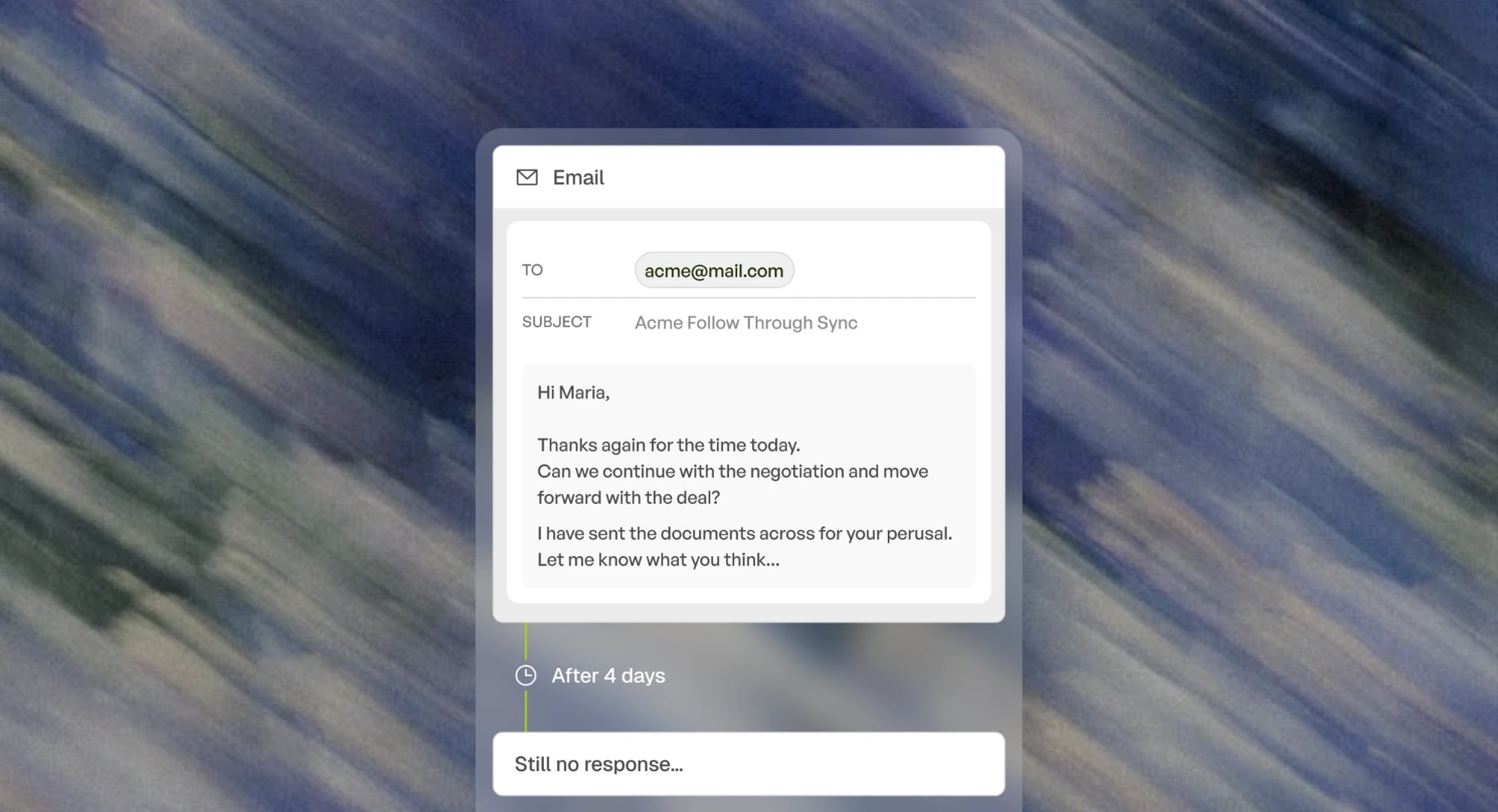
Proposals are easier to talk through than to read, especially if [other decision-maker] wasn't on our call.
Would 15 minutes on [day] or [day] help? I'll take you both through it and answer anything that isn't clear.
[Your name]
Day 5 to 7: add something new
Subject: Re: [Company] proposal
Hi [Name],
On our call you mentioned [their concern]. One thing I didn't put in the proposal: [a short answer, an example from a similar client, or a smaller way to start].
If it would help, I can update the proposal to reflect that.
[Your name]
Day 10 to 14: the honest question
Subject: Timing, price or fit?
Hi [Name],
I haven't heard back on the proposal, so I'd rather ask than guess. Is it the timing, the price or the fit?
Any of those is fine to say. If it's timing, tell me when to come back and I will.
[Your name]
If they give you a date, save it with the reason, and follow our guide on following up with a lead who said "not now". If they don't reply at all, move the deal to your quarterly review of old deals rather than chasing every week.
Make the next proposal easier to say yes to
Most silence starts with the proposal itself. Before you send the next one:
- Put the summary on page one. Their problem in their words, what you'll do, the price and the next step.
- Write for the person who wasn't on the call. They'll read it alone, so don't rely on anything you only said out loud.
- Offer two options, not one. A smaller way to start gives a hesitant buyer something to say yes to.
- Agree the review date before you send it. "Let's go through it on Thursday" turns a silence into a meeting.
- Send it fast. Here's how to send a proposal the same day as the call.
Mistakes to avoid
- Sending "just checking in". It asks for their time and gives nothing back.
- Dropping the price at the first silence. Ask what's in the way first. It may not be the price at all.
- Following up only with your contact. If someone else decides, help your contact make the case to them.
- Chasing forever. After a direct question goes unanswered, save a date and move on.
- Treating silence as a no. Often the timing changed. Ask, and keep the answer on file.
Where Viro fits
The hard part isn't knowing what to send. It's remembering to send it, with the right detail, for every proposal you have out at once.
Viro is the AI-native CRM that works every deal until it’s signed, from the follow-up and proposal when a call ends to the check-in months later, so you close more of the deals you already have. Each follow-up is drafted from what was actually said on the call and waits for you to approve it. Nothing goes out until you say so.
Related: How to stop losing deals after the first sales call · Sales call follow-up email templates · How to follow up with a lead who said "not now" · How Viro follows up